PREVENTION OF DESTRUCTIVE MENTAL STATES OF EMPLOYEES OF THE SOCIO-PSYCHOLOGICAL SERVICE AT THE PENAL INSTITUTIONS BY MEANS OF TRAINING
Keywords:
prevention, destructive mental states, training, training program, training program experimental group, control groupAbstract
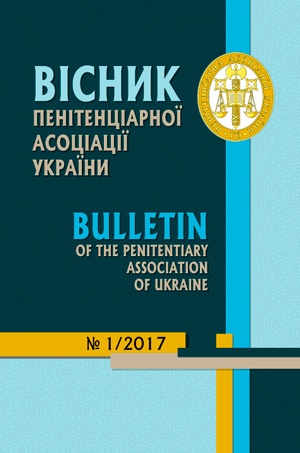
The article envisages the efficiency of implementation of author’s training program aiming at the prevention of destructive mental states of young heads of departments of the social-psychological service at the penal institutions.
The main principles of the author’s training program which was tested in 2014‒2015 on the basis of the correspondence faculty of the Institute of Criminal-Executive service.
The statistical differences between control and experimental groups using a parametric T-criterion of Student test for independent samples are studied.
It is determined that the experimental group unlike the control has decreased isolation, anxiety, tension, timidity, suspicion, rigidity, level of personal anxiety, professional burnout and professional deformation. The level of communication, level of mental and emotional stability, courage, diplomacy, self-control and relaxation has increased.
The main specificity of changes in destructive mental states in the experimental group using nonparametric criterion of Wilcoxon test for dependent samples is revealed. The analysis of changes in the destructive mental states and qualities of the control group before and after training is made using the Wilcoxon test.
It is concluded that for the prevention of destructive mental states of employees of the social-psychological services, the author’s training program appears effective in the work with them, aimed at prevention and correction of destructive mental states of employees of the socio-psychological service that was proved by Wilcoxon test and T-criterion of Student.
References
Downloads
Published
How to Cite
Issue
Section
License
Copyright (c) 2017 M. Chychuha

This work is licensed under a Creative Commons Attribution-NonCommercial-NoDerivatives 4.0 International License.




 CC License Attribution 4.0 International (CC BY 4.0)